
Business Technology
Most SMEs never actually ask whether their technology partner is the right kind of partner — only whether the last problem got fixed. But keeping systems running and deciding what technology a business needs are two different jobs, and confusing them can leave important decisions resting on whoever happens to answer the support line. This article sets out the practical difference between a traditional IT provider and a business technology consultancy: how each is oriented, where each adds the most value, and how to work out which one your business actually needs right now. It’s written for South African SME owners and leaders who want more from their technology relationship than a resolved ticket.
Gridline Digital • 22 August 2026 • 9 min read
Technology problems are not always IT problems.
A business can have reliable computers, a working Microsoft 365 environment and someone to call when something breaks, and still struggle with inefficient processes, disconnected systems, unnecessary manual work or technology decisions that are hard to justify.
This is where the distinction between a traditional IT provider and a business technology consultancy becomes useful.
An IT provider is generally focused on keeping the existing technology environment working, secure and available. A business technology consultancy looks more broadly at how technology should support the organisation’s goals, processes, risk and future direction.
The two roles overlap, and neither is automatically the better choice. The real question is what your business actually needs from its technology partner.
The simplest distinction is one of orientation.
A traditional IT provider is generally operations-led. Its focus is keeping the technology environment running and resolving problems when they occur. Typical responsibilities include help-desk support, device and network management, cloud administration, backups, monitoring, patching and incident response.
The questions tend to be:
What is broken? How do we restore it? How do we keep it running?
A business technology consultancy is generally decision-led. It starts with the organisation’s business requirements and works out what technology should change, why it should change and what outcome the investment is meant to produce. This can include technology assessments, business and process reviews, strategy and roadmaps, solution design, vendor evaluation, digital transformation planning and governance.
The questions become:
What should we change? Why should we change it? Which option is appropriate? How will it improve the business?
This is a useful generalisation, not a rigid industry classification. An IT provider may offer strategic advice, and a consultancy may implement and support technology. What matters is the provider’s actual scope, capability and accountability.
| Area | Traditional IT Provider | Business Technology Consultancy |
|---|---|---|
| Primary purpose | Keep technology available, secure and usable | Ensure technology supports business performance and direction |
| Typical work | Support, troubleshooting, maintenance, monitoring and administration | Assessment, strategy, planning, solution design and technology advice |
| Time horizon | Immediate, ongoing operational continuity | Medium- to long-term change and investment decisions |
| Main questions | What is broken? How do we fix it? | What should we change, why, and what outcome will it produce? |
| Typical stakeholders | Users, IT and operations | Owners, directors, executives and department leaders |
| Success measures | Uptime, response times, resolution, user satisfaction | Business outcomes, productivity, risk reduction, adoption, investment value |

Neither model is inherently better. If your business mainly needs dependable day-to-day IT support, a strong IT provider may be exactly what you need. If the problem is deciding what to invest in, redesigning a process, connecting systems or aligning technology with growth, consultancy-led advice tends to add more value. For many organisations, the right answer is both.
One of the biggest differences is where the conversation begins.
An IT provider typically receives a defined technical requirement: “We need Microsoft 365 support.” “Our network needs attention.” “Our email isn’t working.” These are legitimate requirements, and operational support matters. A consultancy is more likely to ask what sits behind the request — why the current system is causing problems, which business process is affected, whether the issue is really technology, configuration or the way people work, and what the business will need as it grows.
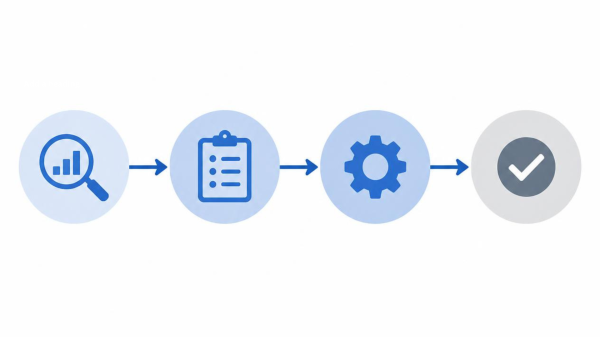
A common version of the same mistake is starting with a product rather than a problem. A business spots a new application, automation tool or AI platform and looks for somewhere to use it. A consultancy-led approach reverses this: understand the requirement first, assess the existing environment and constraints, then decide whether anything actually needs to change.
Consider a professional services firm where staff repeatedly copy information between spreadsheets, email and another business system. The obvious response is to buy another application. The better questions are why the copying happens in the first place, where the authoritative data actually lives, whether the existing systems can already exchange it, and whether workflow automation or better use of the current Microsoft 365 platform would solve most of the problem without adding anything new. Sometimes the right technology decision is to buy less and use what you already have better.
There is a common assumption that consultants only produce recommendations while IT providers do the actual work. In practice, the boundary is not that clean.
IT providers often excel at practical execution — configuring systems, migrating users, deploying devices and maintaining the environment afterwards. Consultancies can also implement technology, particularly where the work involves process redesign, integration, governance or coordination across different parts of the business.
The more useful distinction is this: IT providers are generally accountable for the health of the technology environment. Business technology consultancies are generally accountable for the quality and direction of technology-related business change. There is real value in having someone who can look beyond a single platform and consider how systems, processes and people fit together.
Ongoing support looks different too. Traditional IT support is built around continuity — monitoring, incident response and a predictable channel when something goes wrong. A consultancy is more likely to provide ongoing strategic oversight: reviewing the technology roadmap, assessing new risks, challenging major proposals and supporting vendor decisions. For a growing SME, this doesn’t have to mean hiring a technology executive. It can simply mean having access to the right level of independent advice when it matters.
Consultancy-led advice tends to matter most when a decision is important, cross-functional or hard to reverse.
Businesses often accumulate disconnected systems, spreadsheets and informal workarounds that were fine when the organisation was smaller. As those arrangements start to create bottlenecks, the OECD’s 2025 SME digitalisation research points to digitalisation as a route to improved operational efficiency and access to new markets, alongside real challenges around AI adoption and digital security — a pattern that tracks closely with what growing SMEs experience locally.
Buying an ERP, CRM, cloud platform or AI solution has long-term consequences. A technology adviser helps weigh business requirements, integration, security, scalability, cost, vendor dependency and implementation complexity against each other. The goal isn’t the product with the longest feature list — it’s the approach that actually fits the business.
Technology can hide a process problem. If people spend hours moving information between systems or chasing approvals by email, the answer may not be another application — it may be better process design, workflow automation or integration. Even modest improvements to repetitive processes can free staff for higher-value work.
PwC’s 2025 Global CEO Survey found that 56% of CEOs reported employee time savings from generative AI, with 32% reporting increased revenue and 34% increased profitability — yet almost two-thirds had not yet seen concrete financial results. Using AI is not the same as getting business value from it. Before adopting it, a business should be clear on the problem it’s solving, what data the system will access, how much human oversight is needed, and how the result will be measured.
Security is a business decision as much as a technical one. An IT provider can implement controls, but leadership still needs to understand which processes are critical and where disruption would hurt most, through risk and cybersecurity assessments. The World Economic Forum reported that 35% of small organizations considered their cyber resilience inadequate in 2025, alongside a significant cybersecurity skills gap. The question isn’t only “do we have antivirus and backups?” — it’s also “what happens if a critical system or supplier becomes unavailable?”
Most businesses now depend on several platforms at once — Microsoft 365, accounting software, payment platforms, hosting and CRM systems among them. The more interconnected the environment, the more it matters who owns the data, who controls the accounts, and what happens if a supplier changes its service or the business needs to move away from it. These are technology questions, but they’re also business continuity and governance questions.
“An IT provider only fixes computers.” Not necessarily — many now offer cloud services, managed security and strategic advice. What matters is what the provider is actually accountable for.
“A consultant only produces reports.” A good consultancy can advise, design, coordinate suppliers and stay involved through implementation, provided the engagement clearly defines its scope.
“Consultancy is only for large companies.” SMEs often benefit the most, because they typically have fewer internal specialists to catch a bad decision before it’s made.
“The cheapest IT support is always the better deal.” A low-cost support plan can be entirely appropriate for a simple environment — it just may not include planning, process improvement or security maturity work.
“More technology means a more advanced business.” Extra platforms can add cost, complexity and security exposure. Sometimes the best project is consolidation or better use of what’s already owned.
For a smaller business, technology consultancy doesn’t need to mean a large transformation programme. Good advice is proportionate and practical, and it usually starts with a review of:
The outcome should be a clearer set of decisions — not technology for its own sake. That might mean a roadmap, a process improvement project, Microsoft 365 optimization, workflow automation, platform integration, security improvements, or simply a decision to leave a system alone for now.
The choice isn’t always IT provider versus consultancy. For many SMEs, the strongest arrangement involves both — an operational IT partner keeping the environment running day to day, and a strategically oriented adviser providing independent perspective on the bigger decisions.
The key is clear accountability. Who handles user support? Who owns the technology roadmap? Who evaluates new platforms? Who manages vendors? Who is responsible for security recommendations? Who decides what gets prioritised? Answering these up front prevents important responsibilities falling between the gaps.

These questions shift the conversation away from “what technology do you sell?” and towards “how can technology help us run the business better?”
The difference between an IT provider and a business technology consultancy is ultimately less about job titles and more about the problem being solved.
If your priority is keeping existing technology operational and resolving incidents, an IT provider may be the right fit. If you’re deciding what to invest in, trying to fix inefficient processes, connect disconnected systems or prepare for growth, consultancy-led advice tends to be more useful. And if you need both, there’s no reason the two can’t work together.
What matters most is that your technology partner understands what the business is trying to achieve, and can explain how technology supports that. For Gridline Digital, that’s the purpose of business technology consultancy — to help businesses understand the problem before choosing the technology, improve the process rather than simply automate it, connect systems where it adds value, and build an environment that can support the business as it grows.
If you’re unsure whether your current technology setup is supporting the way your business works, a technology review can help identify where improvements may be needed. Gridline Digital can help assess the relationship between your business processes, technology, security and future requirements, and develop practical recommendations on what should change — and what may not need to.
If you’re unsure whether your current systems, processes and technology are working together effectively, a technology assessment can help identify where improvements are needed.